The short answer
General information, not legal advice. We read these rules on 25 October 2026. Laws and maps change, so check with Council, the relevant State agency or a lawyer for your situation. This guide covers Queensland only. If your property is in another state, check with your local council.
Council protection
Councils set most of the day-to-day rules for trees on private land. In Redland City, some trees are protected, and removing protected vegetation without approval is an offence. Protection can come from the City Plan’s overlays, a covenant, a building or development envelope, a condition on a development approval, or a Vegetation Protection Order. Our guide to Redland City Council tree rules goes through each one, with the fees and who to call.
Other councils have their own rules. Brisbane City Council, for example, issues permits for protected vegetation and asks for an AQF level 5 arborist report for works on a significant landscape tree.
Neighbour trees: the Neighbourhood Disputes Act
Chapter 3 of the Neighbourhood Disputes (Dividing Fences and Trees) Act 2011 deals with trees that affect a neighbour. In short:
- Who is responsible: the “tree-keeper”, usually the registered owner of the land where the base of the trunk is wholly or mainly situated. Queensland Government guidance says a tree on the boundary is shared equally.
- What counts as a tree: woody perennials and vines, with the Act’s examples including bamboo, banana plant, palm and cactus. Dead trees and stumps count too.
- Where it applies: freehold land and some leases. It does not apply to rural land, parcels over 4 ha or council-owned public parks, and it does not override other laws, so a Vegetation Protection Order still applies.
Swipe sideways to see every column →
| Situation | What the Act says | Section |
|---|---|---|
| Branches over a neighbour’s land | The tree-keeper’s duties include “cutting and removing any branches of the tree that overhang”, and making sure the tree doesn’t cause serious injury, serious damage or substantial, ongoing and unreasonable interference. The Act also keeps the common law right of a neighbour to trim branches back to the boundary. | ss 52, 54 |
| A formal notice | For branches at least 50 cm over the boundary and 2.5 m or less above the ground, a neighbour can give written notice allowing at least 30 days, with at least one written quote. Entry is 8 am to 5 pm, never into a dwelling, and only one such notice can be given in 12 months. | s 57 |
| If the notice is ignored | The neighbour may cut the branches or arrange it. The tree-keeper is liable “only to a maximum of $300”, which can be recovered as a debt. | s 58 |
| Higher branches, damage and other problems | These go to QCAT, which must be satisfied the neighbour tried to agree and took reasonable steps under any local law. QCAT “may make the orders it considers appropriate”. | ss 59, 65, 66 |
| Sunlight and views | Only if the tree is at least 2.5 m tall and the effect is “severe”: on the windows or roofs of a dwelling, or on views that existed when you took possession. | s 66 |
QCAT can order a tree to be maintained, order compensation or an arborist report, or, as a last resort, order it removed. Free legal information is available from Legal Aid Queensland and community legal centres. Leaf litter and overhang alone may not earn an order.
Two things to remember. A protected tree stays protected even in a neighbour dispute, so check with Council first. And the pages we read do not say who pays when a neighbour’s tree falls and damages property, so we haven’t said.
Koala habitat in South East Queensland
Since 2020, the Planning Regulation 2017 and the Nature Conservation (Koala) Conservation Plan 2017 protect mapped koala habitat in South East Queensland. In koala habitat areas inside koala priority areas, interfering with the habitat is prohibited unless an exemption applies. Elsewhere it is regulated through development approval.
- What “interfering” means: removing, cutting down, ringbarking, pushing over, poisoning or destroying native vegetation in a koala habitat area. It does not include destroying standing vegetation by stock, or “lopping a tree”.
- Exemptions listed by the State: emergency response, removal of dangerous trees, firebreaks next to infrastructure, a once-off 500 m² allowance per premises, and clearing under State vegetation clearing codes.
- Even if exempt: sequential clearing and koala spotter requirements still apply. The State says: “These requirements apply irrespective of any approval or exemption.”
The State’s koala mapping page shows whether a lot is in a koala habitat area. We could not confirm which Redlands lots are mapped, and we read the State’s page on 25 October 2026 (it showed an update on 21 September 2026), so check it again before you rely on the 500 m² allowance. Council’s tree page also points to the Commonwealth EPBC Act for endangered and vulnerable species such as koalas.
State vegetation rules on urban lots
The State’s vegetation management framework regulates native vegetation only. Land mapped as category X, shown white on the State map, is described as “Vegetation that generally does not require a development approval”. The free State vegetation property report shows whether your lot is category X.
On freehold land the State exempts clearing to remove or reduce the imminent risk of serious injury or damage to infrastructure, and maintaining a garden or orchard if the predominant canopy trees are kept. Even exempt work may need approval under a local law or planning scheme.
Trees near power lines: who is responsible
Energex is the network operator for the Redlands. Who looks after a tree depends on whose line it is near:
| The line | Who deals with the tree |
|---|---|
| Street powerlines | Energex trims trees around its own powerlines and may enter your property to trim a tree growing into the street powerline clearance. It says it normally does this free of charge. Requests go through Energex’s Customer Self Service Portal. |
| The service line from the pole to your house | For trees close to or brushing the service line, Energex says to call a professional arborist or tree trimmer. Who legally pays was not clear from the pages we read, so contact Energex first. |
| A private pole or private powerline on your property | The owner is responsible. The Electrical Safety Office says that “clearing trees away from privately owned powerlines is the responsibility of the property owner”. The Electrical Safety Regulation 2026 (s 23) requires the person in control of a private overhead electric line to make sure trees and other vegetation are trimmed to prevent contact, with a maximum penalty of 40 penalty units. |
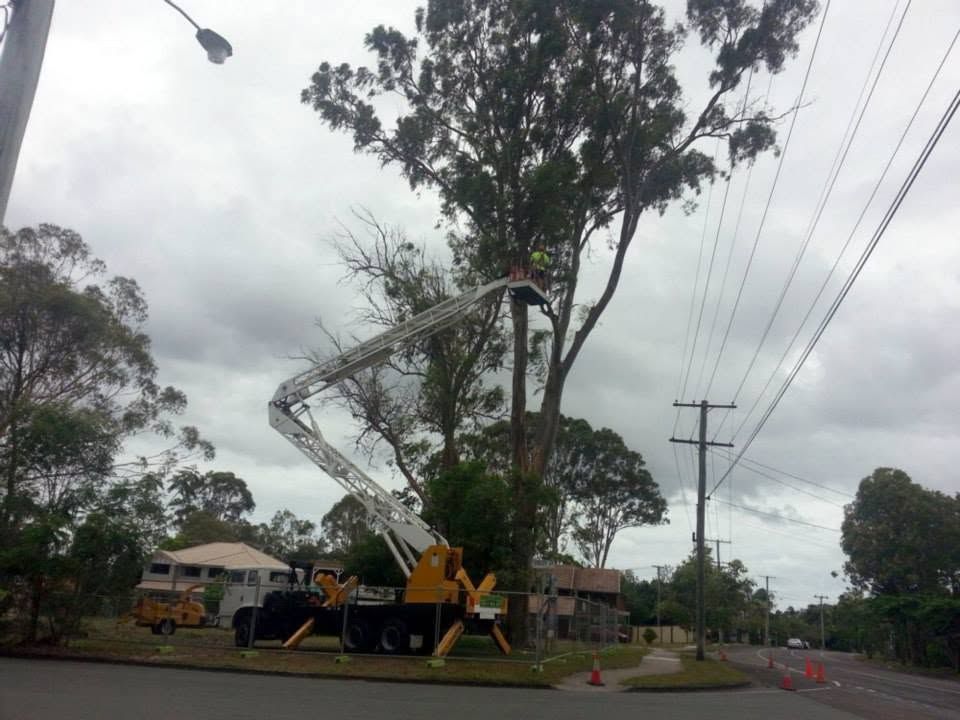
For electricity entities the same Regulation (s 265) requires trees and vegetation near the overhead lines in their works to be trimmed. Energex’s safety message is blunt: “Never attempt to do it yourself.” If a tree is touching powerlines, stay at least 10 metres away and call 000.
Exclusion zones: how close is too close?
The Electrical Safety Regulation 2026 sets exclusion zones around overhead lines. A person, plant or vehicle comes within an exclusion zone if it is inside the distance listed in Schedule 2 (ss 10 and 11), and the “unsafe distance” includes clothing and any conductive object held. A business must make sure, so far as reasonably practicable, that nobody and nothing comes within an unsafe distance of an overhead line (s 13). If that is not practicable, it needs a risk assessment and controls that are consistent with any requirements of the line owner.
For an untrained person near an overhead uninsulated line, Schedule 2 sets these distances:
Swipe sideways to see every column →
| Line | Without consulting the line owner | With consultation |
|---|---|---|
| Low voltage | 3,000 mm | 1,000 mm |
| Above low voltage, up to 33 kV | 3,000 mm | 2,000 mm |
| Plant operated by an untrained person, lines up to 132 kV | 3,000 mm | Not listed |
An “untrained person” is anyone who is not an authorised person or an instructed person working under one. Authorised and instructed people have smaller zones, and insulated lines have their own table. The Electrical Safety Code of Practice 2020, written before the 2026 Regulation, says a person should not do tree trimming where any part of the tree is within the exclusion zones or could fall into them.
So for ordinary people near lines up to 33 kV the distance is generally 3 metres, which is why tree work near lines is a job for professional arborists. Read more in our guides to storm damage tree removal and choosing a tree service.
Questions
Can I remove a tree on my own property without permission?
Sometimes. It depends on your council’s rules and on any covenant, approval condition or Vegetation Protection Order, as well as State rules such as koala habitat. See Redland City Council tree rules and check with Council before you cut.
My neighbour’s tree hangs over my fence. Can I cut it?
The Act keeps the common law right to trim branches back to the boundary, and has a formal notice process for branches at least 50 cm over and no higher than 2.5 m. But a protected tree stays protected, and you should never trim near a powerline. If in doubt, check with Council or ask a crew.
Does the neighbour tree law cover palms?
Yes. The Act’s definition of a tree includes examples such as bamboo, banana plant, palm and cactus, and covers dead trees and stumps.
Do koala rules apply to my backyard?
They can, if your lot is in a mapped koala habitat area in South East Queensland. Check the State’s koala mapping page. Some work is exempt, but koala spotter and sequential clearing requirements can still apply.
Who trims the tree near the power line to my house?
Energex trims trees around its own street powerlines, normally free. For trees close to the line from the pole to your house, Energex says to call a professional arborist or tree trimmer. Contact Energex first and never do it yourself.
Can Tree Problem No Problem handle Council approval?
Yes. If approval is needed, we tell you during the quote and can handle it from Council. Approval is Council’s decision, so we can’t promise the answer.
Sources
- Queensland Parliamentary Counsel, Neighbourhood Disputes (Dividing Fences and Trees) Act 2011, Chapter 3 (current as at 1 August 2025).
- Queensland Government, What to do if a neighbour’s tree is affecting you (updated 9 January 2024) and Your responsibilities as a tree-keeper (updated 21 June 2024).
- QCAT, Tree disputes (updated 18 July 2024).
- Queensland Government, List of exempt clearing work under the Vegetation Management framework (version 1.4, 5 February 2026).
- Queensland Government, Koala mapping and regulation: legislation and policy (updated 21 September 2026).
- Energex, Trees and powerlines and Property poles and privately owned powerlines.
- Electrical Safety Office Queensland, Private power poles.
- Electrical Safety Regulation 2026 (SL 2026 No. 113), ss 10, 11, 13, 19, 23, 265 and Schedule 2 (current as at 1 September 2026), and the Electrical Safety Code of Practice 2020: Working near overhead and underground electric lines, s 6.
- Redland City Council, Trees on private property, and Brisbane City Council, Protected vegetation permits.
Also: how to choose a tree service, arborist reports and lopping vs pruning.