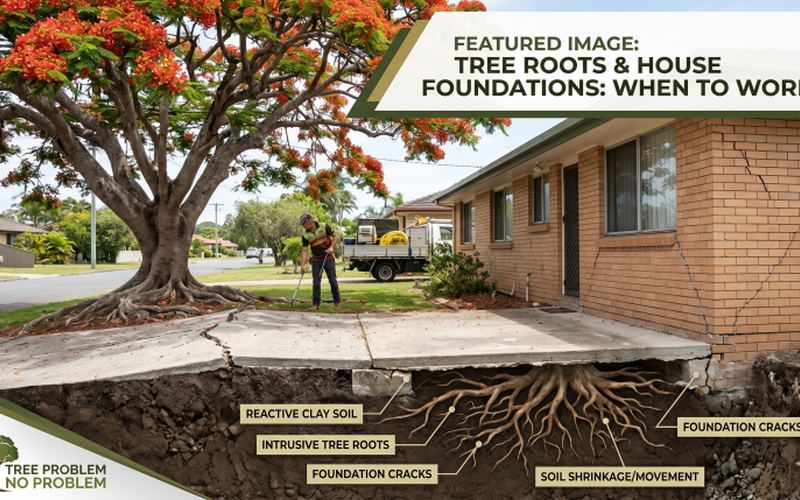
A tree growing close to your house only becomes a foundation risk under specific conditions, usually when its mature root system extends under the slab, the soil is reactive clay, or the tree is a known offender like a fig, poinciana, or large eucalypt. Tree Problem No Problem provides arborist assessments and removal services across Redlands and surrounding suburbs to help homeowners identify the difference between a harmless backyard tree and one that’s quietly compromising the structure of their home.
Do Tree Roots Really Damage Foundations?
Yes, but not in the way most people think. Tree roots don’t usually crack concrete by force, as they’re not strong enough to break through a properly poured slab. What they actually do is far sneakier: they draw moisture out of the soil beneath your house, causing the ground to shrink and shift. That movement is what cracks slabs, walls, and tiles.
Where a property sits on reactive clay soil, this is a real concern. Clay soils swell when wet and shrink when dry, and a thirsty tree accelerates the drying process directly under your foundations.
The other (less common) issue is roots physically lifting paving, driveways, or pool surrounds, which is more cosmetic than structural, but still expensive to fix.
Warning Signs to Watch For
Most root-related foundation issues develop slowly. Catching them early is the difference between a manageable arborist callout and an engineer’s report. Keep an eye out for:
Cracks in internal walls: particularly diagonal cracks above doorways and windows, or cracks that get wider over time.
Doors and windows sticking: a sudden change in how your doors close often means the frame has shifted.
Cracks in the slab or external brickwork: especially stair-stepping cracks running through mortar joints.
Lifted or cracked driveways, paths, or pool surrounds within 5–10 metres of a tree.
Visible surface roots running toward the house.
A tree that’s clearly larger than the property was designed for: original landscaping rarely accounts for 30 years of growth.
If you’re seeing two or more of these signs, it’s worth getting an arborist tree report before the damage progresses.
Which Trees Are the Biggest Offenders?
Not all trees are equal when it comes to foundation risk. The worst culprits in Redlands and SE QLD are:
Figs (Moreton Bay, Hill’s Weeping, Rubber Plant). Aggressive, far-reaching root systems. Should never be planted within 10–15 metres of a structure.
Poincianas. Beautiful canopy, brutal root system. Lifts driveways and shifts foundations regularly.
Large eucalypts (Spotted Gum, Forest Red Gum, Iron Bark). Massive water uptake and deep, far-spreading roots. Particularly damaging on clay soils.
Camphor laurels. Invasive root systems and widely treated as an environmental weed in South East Queensland, so often a removal candidate regardless. Check with your council first (see Redland City Council tree rules).
Jacarandas, leopard trees, large bottlebrushes. Lower-tier risk but still problematic close to slabs.
By contrast, smaller native species like lilly pillies, banksias, and small acacias are generally low risk when planted at sensible distances.
How Close Is Too Close?
There’s no single magic number, but a useful rule of thumb is that the root zone of a mature tree extends to roughly one to one and a half times the height of the tree. A 15-metre eucalypt has a root zone reaching 15–22 metres in every direction.
The real question isn’t “how far do roots reach?” but “how far do they reach and find what they’re looking for?” Roots follow water. If your house has a leaky pipe, a poorly drained downpipe, or a slab edge that holds moisture, roots from much further away will find it.
What Can Be Done?
The right answer depends on the tree, the proximity, and the damage already present:
Assessment first. A qualified arborist can identify whether a tree is actually the cause of damage, or whether something else (poor drainage, soil movement, plumbing leaks) is to blame. A tree should not be removed before it has been confirmed as the culprit. Read more about the dangers of DIY tree removal for why this assessment matters.
Selective root pruning. In some cases, a problematic root can be pruned without removing the tree. This needs to be done by a professional — cutting major roots incorrectly can destabilise the tree and create a falling hazard.
Root barriers. A trench dug between the tree and the house, lined with a physical root barrier, can redirect future root growth. Most effective when installed early.
Crown reduction. Reducing the size of the canopy reduces the tree’s water demand, slowing root expansion. Done properly, this can extend the safe lifespan of a tree near a structure.
Tree removal. Sometimes the tree has to go. If the species is high-risk, the proximity is too close, and damage is already occurring, removal is the most cost-effective long-term solution. We provide tree felling and removal services across Redlands, Capalaba, Victoria Point, Cleveland, and Redland Bay.
When to Call an Arborist
If your house is showing cracks and you’ve got a sizeable tree within about 10 metres, get a professional opinion before assuming the tree is or isn’t the cause. The cost of an arborist report is a fraction of the cost of foundation repair. Just as importantly, it tells you whether the tree is fine, whether it can be managed, or whether removal is genuinely necessary.
Tree Problem No Problem has been providing arborist services across the Redlands for more than a decade. We’re fully insured, our crew are qualified arborists, and we’ll give you a straight answer about your tree and your property.