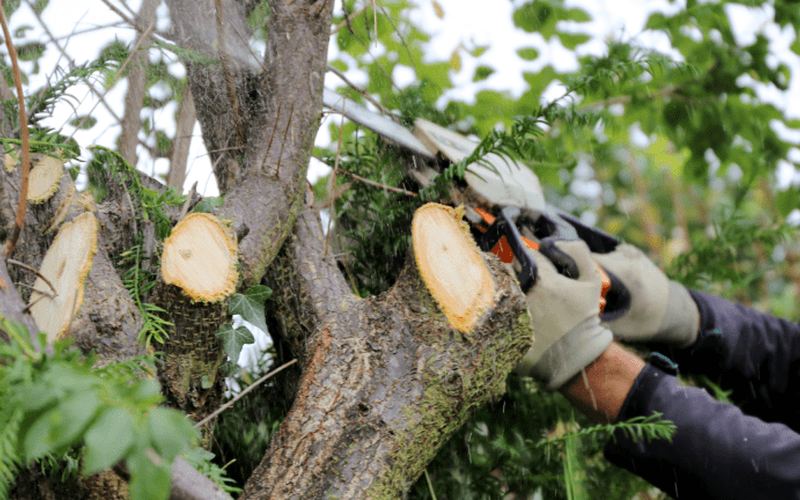
When it comes to removing a tree, it’s not as simple as taking a chainsaw to the trunk and hoping for the best. Tree felling is a skilled process that requires precision, planning, and the right cutting technique. Whether the goal is to bring the tree down safely or in a specific direction, using the correct tree felling cut is critical to protecting nearby structures, people, and the surrounding environment.
Let’s take a look at the main types of tree felling cuts, what they’re used for, and why it’s always best to call in the professionals.
The Basics: What Is a Felling Cut?
A felling cut is the final cut that brings the tree down. It’s made on the opposite side of the tree to the directional notch or face cut. Together, the notch and the felling cut create a controlled hinge that guides the tree’s fall.
Choosing the right type of cut depends on the tree’s size, lean, condition, and surroundings.
1. Conventional Notch (Standard Face Cut)
This is the most commonly used tree felling technique.
- How it works: A horizontal cut is made on the front of the tree, followed by a diagonal cut above it to meet the bottom cut, removing a wedge of wood.
- Best for: Trees with a slight natural lean in the direction you want the tree to fall.
- Advantages: Easy to make, creates a reliable hinge for guiding the fall.
2. Humboldt Notch
This method is popular in professional logging operations.
- How it works: The top cut is horizontal and the bottom cut is angled upwards, removing a wedge.
- Best for: Situations where you want to maximise usable timber or when working on a slope.
- Advantages: Reduces stump height, ideal for cutting timber into logs.
3. Open-Faced Notch
This is a wider notch, often with a 70 to 90-degree opening.
- How it works: Both cuts are made at angles to create a wide face notch. The felling cut is made from behind, leaving a flat hinge.
- Best for: Trees in tight spaces where you need precise control over the fall.
- Advantages: Offers the most control and reduces the risk of barber chairing (a dangerous split of the trunk).
4. Bore Cut (Plunge Cut)
A more advanced technique used in combination with other notches.
- How it works: A chainsaw is used to plunge into the centre of the tree before completing the felling cut. This allows the hinge to be established before the back cut is complete.
- Best for: Leaning trees, or when working with larger trees that pose more risk.
- Advantages: Reduces the risk of uncontrolled movement, especially with back-leaning or heavy trees.
5. V Cut or V Notch
Less common, but used in certain technical or tricky fells.
- How it works: Two diagonal cuts are made to create a V shape, with no horizontal cut.
- Best for: Specific applications, such as directional felling in confined spaces.
- Advantages: Can help control tricky falls when used with other techniques.
Safety First: Tree Felling Is Not a DIY Job
Using the wrong cut, or using the right one incorrectly, can result in serious accidents, property damage, or injury. Tree felling involves a deep understanding of tree structure, tension, weight distribution, and site conditions.
That’s why it’s always safest to hire trained professionals who know which cuts to use, when to use them, and how to control a tree’s fall with precision.
Leave It to the Experts at Tree Problem No Problem
At Tree Problem No Problem, our qualified arborists are trained in tree felling techniques. Whether you need a small tree removed from your backyard or a large, dangerous tree taken down near powerlines or property, we’ve got the skills, tools, and safety protocols to get it done right.