Arborists are responsible for the care, maintenance, and preservation of trees. A crucial part of their job involves climbing trees, whether for pruning, removal, or simply to assess the tree’s health. But how exactly do arborists ascend these towering giants safely and efficiently? In this blog post, we will explore the fascinating world of arborist tree-climbing techniques.
1. Harness and Rope
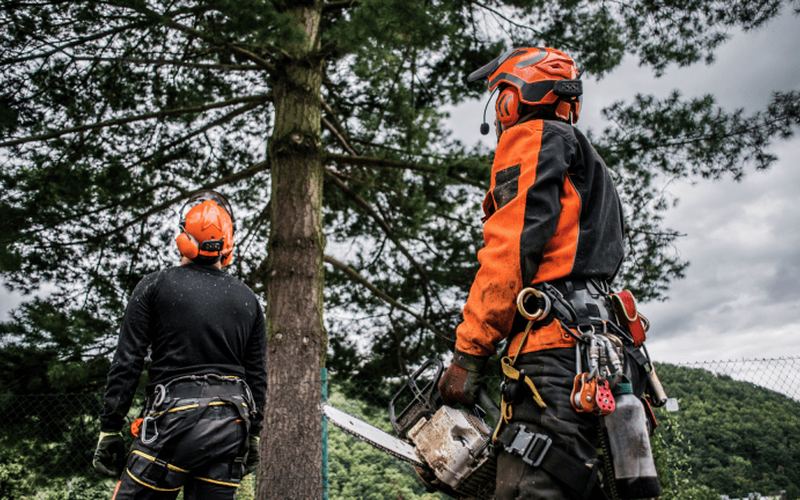
One of the fundamental tools of an arborist is a full-body harness, which provides both support and safety while climbing. Arborists wear a specialised saddle that fits snugly around their hips and thighs. Attached to the saddle is a series of loops and straps, creating attachment points for ropes, carabiners, and other gear.
2. Ropes and Knots
Arborists use dynamic climbing ropes specifically designed for tree work. Various knots, such as the Bowline, Blake’s hitch, or Prusik, are used to create secure connections to branches and limbs. They must be skilled in knot-tying, as their lives depend on it.
3. Climbing Spurs and Gaffs
When a tree is being removed, arborists often employ climbing spurs, also known as gaffs. These are sharp spikes attached to their boots, providing traction as they ascend the tree. Gaffs are not used on live, healthy trees that are staying, because the spikes wound the bark. Spurless climbing techniques are used on those trees instead.
4. Rope Ascension Techniques
Arborists typically use either a double rope technique (DRT) or a single rope technique (SRT). In SRT, the arborist ascends using a single rope. This method relies on a mechanical ascender that allows controlled movement upward. For DRT, the arborist uses two ropes, one for climbing and one for backup. They ascend by alternately moving the two ropes through a friction hitch device.
5. Aerial Lifts and Platforms
For large trees or projects that require significant work at height, arborists may opt for aerial lifts or platforms. These machines allow arborists to access the canopy more comfortably and safely, making it easier to carry out pruning, maintenance, or removal.
6. Safety First
Safety is paramount for arborists, and they undergo extensive training to ensure their safety and that of the trees they work on. Proper safety procedures, regular equipment inspection, and the use of personal protective gear are essential for every tree-climbing operation.
7. Experience and Skill
Climbing trees as an arborist requires both experience and skill. Arborists must assess each tree’s structure and select the best climbing method for the situation. They also need to understand tree biology and health to avoid causing damage during the ascent.
With their specialised gear, ropes, knots, and techniques, arborists ascend into the world of treetops with care, precision, and a deep respect for the trees they serve. Their commitment to maintaining the health and beauty of our arboreal companions ensures that we continue to enjoy the many benefits that trees provide to our environment and well-being.